Sttellar Dawang Editorial Team
Posted on 2026-03-23


Posted on 2026-03-23
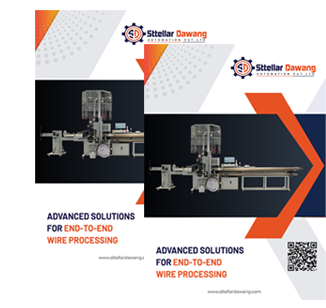
Wire processing is a labour-intensive, repetitive operation that forms the backbone of harness and cable assembly manufacturing. Every second saved per wire, and every defect prevented, has a compounding impact on profitability. Stellar Dawang's fully automatic wire processing machines are engineered specifically to drive time and cost out of wire processing — without compromising quality.
A fully automatic wire processing machine integrates multiple wire processing operations — cutting, stripping, marking, tinning, and crimping — into a single, continuous automated workflow. Wire is fed from a reel, processed through each station according to a programmed specification, and output as finished wire assemblies ready for harness assembly. The entire process runs with minimal operator intervention.
Fully automatic wire processing machines dramatically reduce production cycle times by automating multiple operations within a single workflow and minimising manual handling between processing stages.
In a manual or semi-automated line, operators handle wires between each processing station — cutting, then moving to stripping, then to crimping. Fully automatic machines eliminate this inter-operation handling entirely, reducing cycle time per wire by 40 to 70 percent depending on the complexity of the specification.
Stellar Dawang machines feature digital job storage with instant recall. Switching from one wire specification to another takes seconds rather than the 30 to 60 minutes required to mechanically readjust semi-automatic equipment. This agility is invaluable in high-mix production environments.
Beyond time and cost, fully automatic wire processing machines deliver a quality consistency that manual operations cannot replicate. Integrated inspection systems check cut length, strip length, and crimp height on every wire, automatically rejecting out-of-specification parts. This in-process quality control reduces reliance on end-of-line inspection and protects your customers from receiving defective wire assemblies.
Stellar Dawang offers a comprehensive range of fully automatic wire processing machines — from standalone cut-and-strip centres to multi-station systems integrating marking, tinning, crimping, and seal insertion. All machines feature touchscreen HMI, servo wire feed, and Ethernet connectivity for Industry 4.0 integration with MES and ERP systems.
Fully Automatic Wire Processing Machines from Stellar Dawang are the most effective lever available to manufacturers seeking to reduce wire processing time and costs while improving quality. The ROI is measurable, rapid, and sustained. Contact Stellar Dawang today to model the ROI of automation for your specific wire processing operation.
Solder joint quality is one of the most critical determinants of electrical connection reliability. A poorly formed solder joint — whether due to insufficient heat, wrong dwell time, or flux contamina...
Read More
A wiring harness is the nervous system of any vehicle, machine, or electronic system. A single undetected fault — a missing connection, a miswired terminal, or inadequate insulation — can cause system...
Read More
Twisted wire pairs are a fundamental building block of modern electrical and data systems. By twisting two wires together at a controlled pitch, manufacturers achieve electromagnetic interference (EMI...
Read MoreSign up today Writing copy is time-consuming and difficult. Headlime's artificial intelligence can take your thoughts.